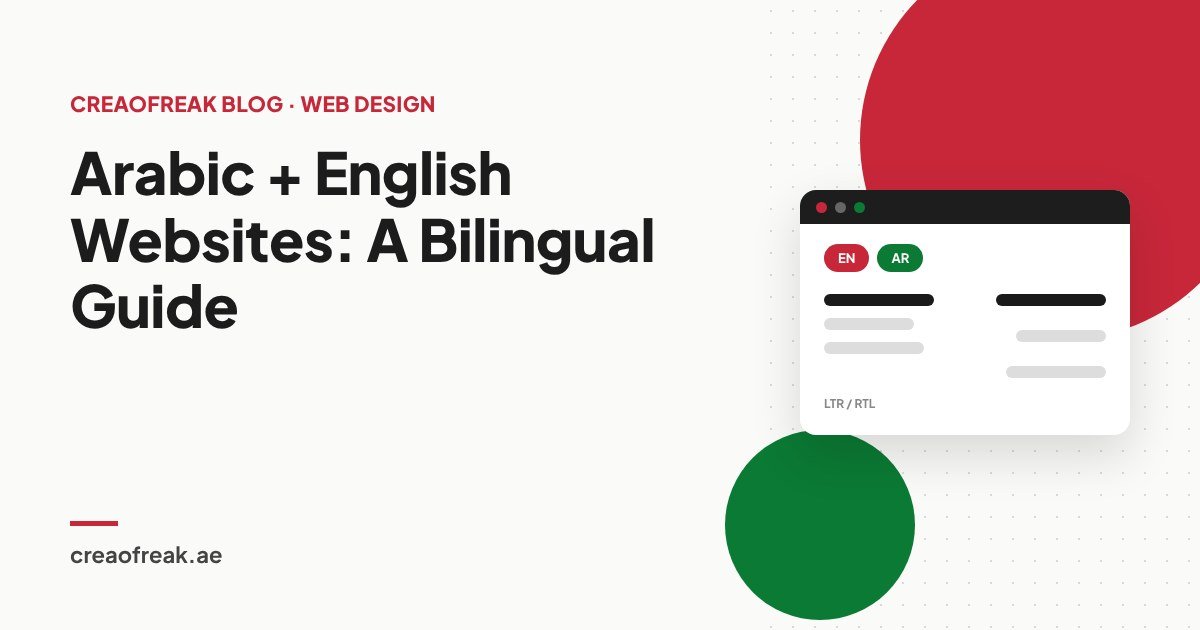
In Dubai, your customers may read your website in English on Monday and search for you in Arabic on Tuesday. Arabic is the official language of the UAE, while English is the everyday language of business for a large, international population. A website that speaks only one of them leaves visitors, and search traffic, on the table. An Arabic and English website lets you reach both.
But a bilingual website is more than a translate button. Done badly, it confuses visitors and search engines. Done well, it builds trust with Arabic-speaking customers, helps you rank in two languages and makes your brand feel local. This guide walks you through how to plan, design and optimise one the right way.
Key takeaways
- Give every language its own URL, such as /en/ and /ar/. Avoid switching languages on the same URL.
- Connect each page to its translation with hreflang tags so Google shows the right version to the right searcher.
- Arabic needs a true right-to-left (RTL) layout, not just mirrored text.
- Localise rather than translate: research Arabic keywords separately and write for how people actually search.
Why an Arabic and English website matters in the UAE
The UAE is almost entirely online. DataReportal’s Digital 2026 report counted 11.3 million internet users, or 99% of the population, at the end of 2025. That audience includes Emirati families, Arabic speakers from across the region and expatriates from around the world.
Search has become bilingual too. Google’s AI Overviews launched in the UAE in 2025 with Arabic support, and Google added Arabic to AI Mode in October 2025. If your content exists only in English, you cannot appear for searches made in Arabic. If you serve government entities, healthcare, education, real estate or family-focused services, Arabic content is often expected rather than a bonus.
Step 1: Choose the right URL structure
Google’s guidance on multilingual sites is clear: use a separate URL for each language version. Google recommends against using cookies or browser settings to change the language of the same page, because its crawlers may only ever see one version.
The three common options are:
- Subdirectories: example.ae/en/ and example.ae/ar/. This is usually the simplest choice for growing businesses because both languages share the same domain authority.
- Subdomains: en.example.ae and ar.example.ae. This works, but it is often harder to manage.
- Separate domains: rarely needed unless you run separate brands.
For most Dubai businesses, we recommend subdirectories. Add a clear, visible language switcher on every page, and let visitors choose. Google advises against automatically redirecting people based on their perceived language, since it can stop both users and crawlers from reaching the other version.
Step 2: Set up hreflang correctly
Hreflang tags tell Google that two pages are translations of each other. Google’s documentation on localised versions sets out the rules. A typical setup looks like this:
- The English page links to itself with hreflang=”en” and to the Arabic page with hreflang=”ar”.
- The Arabic page does the same in reverse. Hreflang must be bidirectional: if page A points to page B, page B must point back to page A.
- Add an x-default version for visitors whose language does not match either version, usually your English page or a language selection page.
If you use WordPress, multilingual plugins such as WPML, Polylang or TranslatePress can generate hreflang tags automatically and help you include every language in your sitemap. Always check the output in Google Search Console after launch.
Step 3: Design for right-to-left, not just in Arabic
Arabic reads from right to left, so the whole interface needs to follow. A true RTL design includes:
- The page direction set to RTL (dir=”rtl” in the HTML) so text, menus and columns flow correctly.
- Mirrored layouts: navigation, sliders, progress bars and directional icons such as arrows should flip.
- Elements that should not flip: logos, phone numbers, product codes, media player controls and charts usually keep their original direction.
- Arabic web fonts designed for screens, with comfortable line height. Arabic script often needs more vertical space than Latin text.
- Mixed text testing: brand names, prices and English terms inside Arabic sentences must display in the right order.
A mirrored website is not the same as a localised website. Arabic readers notice the difference immediately.
Step 4: Localise your content and keywords
Machine translation can be a helpful first draft, but it is rarely ready to publish. Ask a native Arabic writer to review every page so the tone matches your brand, and make sure the Arabic and English pages give visitors the same information.
Just as important, research Arabic keywords separately. People do not always search for the literal translation of your English keywords. They may use different phrases, Gulf dialect terms or a mix of Arabic and English. Build your Arabic page titles, headings and meta descriptions around how your customers actually search, not around a word-for-word translation.
Remember the details that build trust: local phone formats with +971, addresses written the way locals expect, prices in AED and service hours that reflect the UAE working week.
Step 5: Optimise both languages for SEO
- Unique metadata: every language version needs its own title tag and meta description.
- Translated URLs where practical: readable slugs help both users and search engines.
- Both versions in your XML sitemap, submitted in Google Search Console.
- Internal links within each language, so an Arabic visitor can browse your whole site in Arabic.
- Your Google Business Profile should be accurate and consistent with the details on both versions of your website.
These steps also help you appear in AI search, which we cover in our guide to SEO in Dubai in 2026.
Common bilingual website mistakes
- A translate widget instead of real pages. Automatic in-browser translation creates no Arabic pages for Google to index.
- Half-translated sites. Arabic menus that lead to English-only pages frustrate visitors.
- Missing return links in hreflang. Google may ignore hreflang tags that are not confirmed by both pages.
- Images with embedded English text on Arabic pages.
- Forgetting forms, emails and WhatsApp messages. The whole customer journey should continue in the visitor’s language.
Frequently asked questions
Do I need an Arabic version of my website in Dubai?
It depends on your audience. If you serve Emirati customers, Arabic speakers from the region, government clients or families, an Arabic version builds trust and lets you appear in Arabic searches. Many businesses start with their most important service pages and expand from there.
Is it better to use subdirectories or separate domains?
For most businesses, subdirectories such as /en/ and /ar/ are the easiest to manage and keep all your SEO strength on one domain. Google supports all three structures as long as each language has its own URL.
Can I use Google Translate for my Arabic pages?
Machine translation is useful as a draft, but publish only after a native speaker has reviewed it. Low-quality translated content can hurt both user trust and your search performance.
Does Google use the lang attribute to detect page language?
Google says it determines a page’s language from its visible content rather than from code such as the lang attribute. You should still set lang and dir attributes correctly, because browsers, screen readers and RTL layouts depend on them.
Build a website that speaks to all of Dubai
Creaofreak designs responsive WordPress websites for UAE businesses, with layouts, SEO and content planned for both Arabic and English audiences. Explore our web design services, browse our blog, or read why a strong website matters in No Website, No Trust from our Canada team.
Let’s grow your visibility
Tell us about your business and goals, and we will suggest where to start.